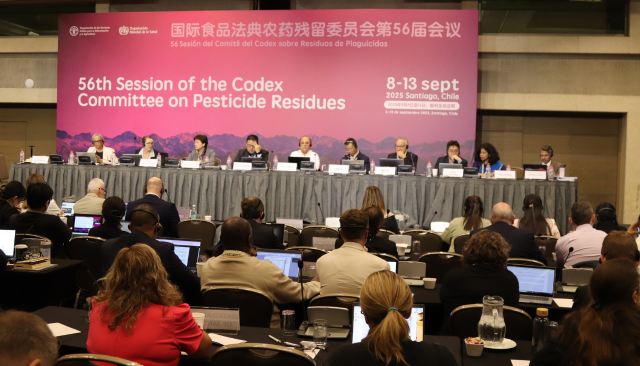
Photo credit: FAO/WHO Codex Alimentarius
The 56th session of the Codex Committee on Pesticide Residues (CCPR56) recently took place in Santiago, Chile. During the meeting, CCPR56 proposed revocations and Codex maximum residue levels (CXLs) for various substances.
Proposals for revocation:
- Carbendazim (related to the fungicides of benomyl and thiophanate-methyl): Existing CXLs (including for apricots, peanuts, and tree nuts) were recommended for revocation.
- Phosmet: Various CXLs, including for apricots, cranberries, and grapes, were recommended for revocation. For now, the CXL for tree nuts (0.2 mg/mg) will be retained under the four-year rule, as the registrant plans to submit additional residue data.
- Fenpyroximate: The CXLs for dried grapes and stone fruits were recommended for revocation.
- Parathion-methyl: The CXL for dried grapes was recommended for revocation.
New proposed/revised CXLs:
- Methoprene: The CXL for tree nuts (3 mg/mg) was recommended for adoption. The EU and Switzerland expressed reservations due to the lack of toxicological data evaluated at the EU level.
- Fluoxapiprolin: The CXL for dried grapes (0.5 mg/kg) was recommended for adoption.
- Phosmet: The CXL for dried cranberries (3 mg/kg) was recommended for adoption. The EU and Switzerland expressed reservations, citing health risks identified for their consumers.
Other matters of interest to the nut and dried fruit industry:
- Piperonyl butoxide: CCPR56 agreed to retain the CXLs of this compound, pending data submission and review by the Joint FAO/WHO Meeting on Pesticide Residues (JMPR).
- Folpet: CCPR56 agreed to retain the CXLs for dried grapes under the four-year rule.
- Clothianidin/thiamethoxam: Iran mentioned that they are working to get a higher MRL for thiomethoxam and its metabolite clothianidin (the current CXL for tree nuts is 0.01 mg/kg). Iran recalled that, at CCPR55, it had committed to providing data for clothianidin on pistachio for evaluation by the JMPR. Iran informed the Committee that although clothianidin was no longer registered for use on pistachio, they requested to retain the MRLs as clothianidin residues could arise from the registered use of thiamethoxam. Iran plans to start residue trials this coming year and committed to submit residue data for review by the 2027 JMPR. Iran nominated thiamethoxam and clothianidin for pistachios for inclusion in the priority list for 2027.
- Methyl bromide: At CCPR55, the JMPR secretariat noted that the current CXLs were guidance numbers, not CXLs. CCPR54 decided to enter methyl bromide into the step process as if it were a new compound. However, to date no registrant(s) have committed to submitting the needed toxicological and residue data for review by JMPR.
- In recent years, no limits have been proposed for dried fruits (e.g., figs, dates) or peanuts, despite their high level of international trade. We encourage INC members to share with us if there are any missing CXLs. You can contact us at inc[at]nutfruit.org
Final decisions regarding the actions discussed at the CCPR56 will be made at the Codex Alimentarius Committee meeting scheduled to take place in November 2025.