
EU Suspends Customs Tariffs on Nitrogen-Based Fertilizers for One Year
On May 22, 2026, the Council of the European Union approved a one-year suspension of customs duties on nitrogen-based fertilizers, including urea and ammonia, with an estimated savings of €60 million for EU farmers and the fertilizer industry. The suspension excludes imports from Russia and Belarus and is capped at a quota equivalent to 2024 MFN import volumes plus 20% of volumes previously sourced from those two countries. The regulation entered into force the day after its publication in the Official Journal of the European Union and shall apply until May 31, 2027.
The decision comes after a sharp spike in fertilizer prices caused by the conflict around the Strait of Hormuz.
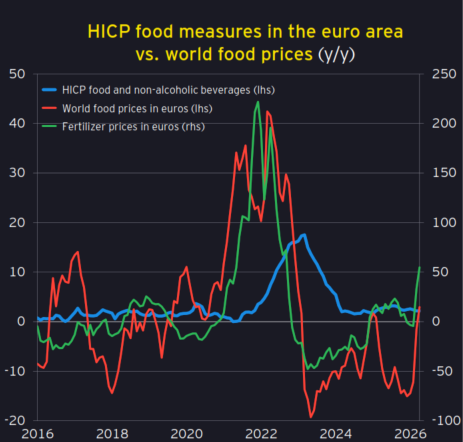
Source: EY’s June 2026 European Economic Outlook.
North American Agriculture Coalition Urges Renewal of USMCA Ahead of July 1 Review
Nearly 160 food and agriculture organizations from the United States, Canada and Mexico sent a joint letter on June 5, 2026, to trade officials in all three countries urging the renewal and strengthening of the United States–Mexico–Canada Agreement (USMCA)—which governs a significant share of cross-border nut and dried fruit trade—ahead of the agreement’s mandatory six-year review, scheduled for July 1, 2026. The review could result in a 16-year extension, termination of the agreement, or annual consultations if the parties cannot reach consensus.
Organized by the Agricultural Coalition for USMCA, signatories include the American Farm Bureau Federation, the National Association of State Departments of Agriculture (NASDA), Farmers for Free Trade, the Canadian Agri-Food Trade Alliance and Mexico’s Consejo Nacional Agropecuario. The coalition argued that the agreement’s integrated structure—spanning more than 500 million consumers and approximately US$1.7 trillion in annual trade volume—provides the predictability North American agricultural trade depends on. Signatories emphasized that outstanding disputes should be resolved through existing mechanisms rather than unilateral retaliatory measures.
India-US Trade Talks Conclude in New Delhi; First Tranche of Bilateral Agreement Targeted for Mid-July
A US delegation was in New Delhi from June 2-4, 2026 to advance the interim bilateral trade agreement, with both sides reaffirming their commitment to a Bilateral Trade Agreement covering goods, non-tariff measures and customs facilitation. Speaking on June 5, Indian Commerce Minister Piyush Goyal told Business Standard that the two countries are close to concluding open issues and could execute the first tranche by mid-July, with a high-level US team expected in New Delhi toward the end of June.
Under the US-India Joint Statement of February 7, 2026, India committed to eliminate or reduce tariffs on a range of US food and agricultural products. Tree nuts are among the products in scope.
USDA Trade Mission Targets Expansion of US Tree Nut Exports in Argentina and Ecuador
In early June 2026, the USDA Foreign Agricultural Service (FAS) launched a trade mission to Argentina and Ecuador aimed at converting existing trade framework commitments into increased export sales for US agricultural products, including tree nuts. The mission, led by the Under Secretary for Trade and Foreign Agricultural Affairs, includes business-to-business meetings and direct engagement with local buyers and government officials.
Ecuador has committed under its trade framework with the United States to eliminate or reduce tariff barriers on tree nuts and other agricultural products. The mission is expected to support US nut exporters in strengthening their market position across Latin America.
USDA Opens Applications for US$1.625 Billion Specialty Crop Farmers Assistance Program; Tree Nuts and Dried Fruits Eligible
The USDA finalized the Assistance for Specialty Crop Farmers (ASCF) Program on May 29, 2026, making US$1.625 billion in one-time bridge payments available to producers of eligible fruits, vegetables and tree nuts based on 2025 planted acreage, according to FreshPlaza. Applications opened June 1 and close August 7, 2026, under the broader Farmer Bridge Assistance Program.
Eligible nut and dried fruit crops include almonds, cashews, hazelnuts, pecans, pistachios, walnuts, apricots, cranberries, grapes (processed), prunes and raisins. Payments range from US$25 to US$650 per acre across four revenue-based tiers. Producers must have filed a 2025 crop acreage report (FSA-578) by April 24, 2026. Pre-filled applications have been available online since June 1 and in-person at local FSA offices since June 8.
Kenyan Macadamia Sector Calls for Temporary Export Ban Suspension as Stockpiles Mount
Macadamia growers in Kenya have renewed calls for government intervention to address a growing backlog of unsold produce, including a proposal to temporarily suspend the ban on the export of raw, in-shell macadamia nuts, according to The Standard. Speaking at a stakeholder meeting convened by the Agriculture and Food Authority (AFA) at KALRO Seeds in Thika on June 5, 2026, Mt Kenya Macadamia Cooperative Society Chairman Gitonga Gathua said farmers are facing significant hardship due to limited processor purchasing capacity and accumulating on-farm stockpiles.
Stakeholders proposed that the export ban be suspended for at least six months to allow inventories to clear and reduce the risk of quality deterioration from prolonged storage. A parallel proposal called for government-backed commodity financing to allow cooperatives to purchase produce from farmers directly before supplying processors. Acting AFA Director of the Nuts and Oil Crops Directorate John Athola acknowledged the challenges; recommendations are to be forwarded to the Cabinet Secretary for Agriculture.
Taiwanese Government Moves to Protect Domestic Peanut Varieties Amid Trade Liberalization Concerns
Taiwan’s agricultural authorities are pursuing two parallel measures to protect the competitive position of domestic peanut growers. According to the Taipei Times, the Taiwan Ministry of Agriculture is advancing restrictions on the export of peanut seeds under the Plant Variety and Plant Seed Act, targeting high-value varieties such as Tainan No. 14 and Black King Kong—considered central to Taiwan’s premium peanut identity—at risk of unauthorized transfer abroad.
Separately, the government is taking steps to support domestic growers facing potential competition from US peanut imports under the Taiwan-US Agreement on Reciprocal Trade (ART), according to another article in the Taipei Times. Measures include purchasing fresh peanut pods, establishing drying centers to reduce production costs and requiring processed products to clearly indicate country of origin. Peanut cultivation in Taiwan has declined from approximately 19,000 hectares in 2020 to 15,000 hectares in 2025.