
US Senate Agriculture Committee Publishes Draft Text of Farm Bill
The chairman of the US Senate Agriculture Committee released a draft text of the new Farm Bill in late June 2026. The bill would increase annual funding for agricultural trade promotion and facilitation from US$255 million to US$515 million for fiscal year 2027, and then to US$533 million for fiscal year 2028 and each fiscal year thereafter. This includes increasing funding for the Market Access Program (MAP) from US$200 million to US$421 million for fiscal year 2027, and then to US$437 million for each of fiscal years 2028 through 2031. This also includes increasing funding for the Foreign Market Development Program (FMD) from US$34.5 million to US$73.5 million for fiscal year 2027, and then to US$75.5 million for each of fiscal years 2028 through 2031. The bill would also create a specialty crop mechanization and automation research and development program and allocates US$30 million per year for the new program.
US Bill Seeks to Expand H-2A Farm Labor Program
Successful Farming reported on July 1 that Rep. Glenn “GT” Thompson (R-Pa.) has introduced the Securing Agriculture’s Workforce Act of 2026 (H.R. 9535), a bill aimed at expanding access to the H-2A agricultural labor visa program. The legislation would remove the requirement that H-2A work be seasonal, clarifying that “temporary” refers to the length of the job contract—up to 350 days—rather than the nature of the work. It would also transfer authority to define “agricultural labor and services” to the Secretary of Agriculture, expand eligibility to sectors such as controlled environment agriculture, forestry and aquaculture, and streamline application processes and cost controls.
The proposal has drawn strong support from major farm organizations. The American Farm Bureau Federation described it as “meaningful farm labor reform,” noting that only 182 domestic applications were submitted for nearly 415,000 advertised agricultural positions in 2025. Western Growers, whose members and workers supply more than half of the country’s fresh fruits, vegetables and tree nuts, welcomed the bill as an important step to streamline the program, reduce administrative burdens and provide greater certainty around wage rules, highlighting that the national average Adverse Effect Wage Rate rose 45% between 2018 and 2025. However, the article notes that groups such as the United Farm Workers, the United Food and Commercial Workers, and the National Farmers Union have raised concerns about the bill.
EU Plant Protection Products Update
Following the addition of chlorpyrifos to the Stockholm Convention on Persistent Organic Pollutants in 2025, the European Commission has adopted its initiative to classify this substance accordingly in its own legislation. A delegated regulation (available here in draft form) will amend Regulation (EU) 2019/1021, which implements the EU’s international commitments under the Stockholm Convention, to include chlorpyrifos in Annex I as a substance subject to certain restrictions.
In other news, the EU has notified the World Trade Organization (WTO) of a draft implementing regulation concerning the non-renewal of the approval of the active substance buprofezin. According to a peer review by the European Food Safety Authority (EFSA), buprofezin meets the criteria to be considered an endocrine disruptor. October 2026 has been proposed as the date of adoption of the implementing regulation. EU Member States will be required to withdraw existing plant protection products containing buprofezin at the latest by 6 months from the date of entry into force. The final date for comments is August 31, 2026.
Finally, following unilateral actions by France and Poland earlier this year, the EU has published Commission Regulation 2026/1546, which updates the maximum residue levels (MRLs) for benomyl, carbendazim and thiophanate-methyl in or on certain products, including the following:
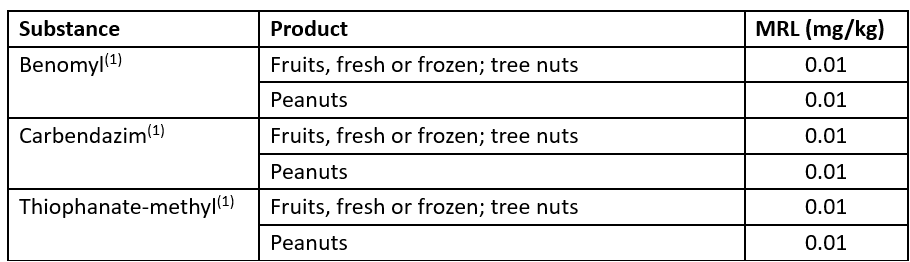
(¹) Date of application: January 29, 2027.
The regulation provides for a transitional arrangement for products placed on the market before said date.
Draft Gulf Standard for Unshelled Pistachio Nuts
The United Arab Emirates, Bahrain, Kuwait, Oman, Qatar, Saudi Arabia and Yemen have jointly notified the World Trade Organization (WTO) of a draft Gulf Standard (GSO FDS 1358) on unshelled pistachio nuts.
The standard applies to the fruits of unshelled pistachio nuts processed and intended for direct consumption, as well as to bulk unshelled pistachio for repackaging in consumer-sized containers. Products intended for industrial processing are excluded from the scope. The stated objectives are consumer information and labeling, protection of human health or safety, and quality requirements.
According to an analysis by EY, GSO FDS 1358 sets out the technical requirements for the product. Pistachios are classified by size into five categories based on the number of nuts per 100 g: small (>106), medium (92-106), larger than medium (81-91), large (71-80) and extra-large (<71), with a 5% tolerance for adjacent sizes. The standard requires the fruits to be clean, sound and ripe, free from live insects, coloring matter and foreign material, with the shell naturally or artificially split, free from rancidity and off-odors or off-flavors, and with whole kernels free from damage caused by insects, mold or mites.
The regulation establishes a maximum moisture content of 7%, a maximum of 1 g/kg of mineral impurities, and specific defect limits: closed (unsplit) nuts ≤5%, empty nuts ≤5%, unripe nuts ≤8%, insect-damaged nuts ≤4% and mold-affected nuts ≤1%, with a total defect limit of 10%. Contaminants, toxins, pesticide residues and microbiological limits must comply with referenced Gulf Standards (GSO 193, GSO 382 and GSO 1016).
The technical regulation is based on Codex Standard CXS 131-1981 (as amended in 2022 and 2023) for unshelled pistachios. The proposed dates of adoption and entry into force are to be determined, and the final date for comments is August 30, 2026.
Đồng Nai Pursues Plans to Become an International Cashew Trading Hub
Đồng Nai is advancing plans to develop a more competitive and sustainable cashew sector, with the objective of establishing itself as an international cashew trading hub, according to Việt Nam News. The city has developed an integrated cashew ecosystem that includes cultivation, processing, machinery manufacturing, logistics, exports and supporting industries. Authorities and industry representatives identified value-added processing, stronger supply-chain linkages and greater integration into global markets as priorities for future development.
The report notes that the cashew sector continues to face challenges, including dependence on imported raw materials, climate-related pressures, inconsistent raw material quality and increasing competition from foreign processors. Industry representatives also highlighted the need for greater adoption of digital technologies and stronger branding.
According to local authorities, efforts are underway to strengthen specialized cashew-growing areas, rejuvenate ageing orchards, expand the use of certified planting material and improve traceability systems. The strategy also includes support for processing technologies, product diversification, cooperative development and the promotion of the “Đồng Nai Cashew” brand.
Export Cluster Initiative Targets Cashew Sector Development in Nigeria
According to recent reporting by the Nigerian Tribune, the Nigerian Export Promotion Council (NEPC) is strengthening efforts to develop export clusters around cashew, sesame and soybean in Kwara State. The initiative was discussed during a stakeholder meeting involving government representatives, farmers, exporters and private-sector operators.
NEPC officials stated that cashew has been identified as one of the priority commodities for the program. The Council indicated that the creation of export clusters would help connect producers, processors, marketers and exporters within the same value chain to improve coordination and support access to international markets.
Himachal Pradesh Launches High Value Nut Mission
The Himachal Pradesh government in India has announced the launch of the High Value Nut Mission for the period 2026-2031, according to the Daily Excelsior. The initiative will promote the cultivation of high-value temperate crops, including walnuts, almonds, chilgoza pine nuts and apricots.
The mission seeks to address challenges including ageing orchards, low productivity, inadequate post-harvest infrastructure and limited value-addition opportunities. As part of the initiative, around 1,000 hectares will be covered under orchard rejuvenation and high-density plantation programs. The government also plans to establish four high-tech nurseries and two centers of excellence in nut-growing regions.