Codex Alimentarius has issued circular letter CL 2026/30-PR inviting Codex members and observers to comment on the MRLs proposed by the 2025 Joint FAO/WHO Meeting on Pesticide Residues (JMPR).
The proposed MRLs include the following:
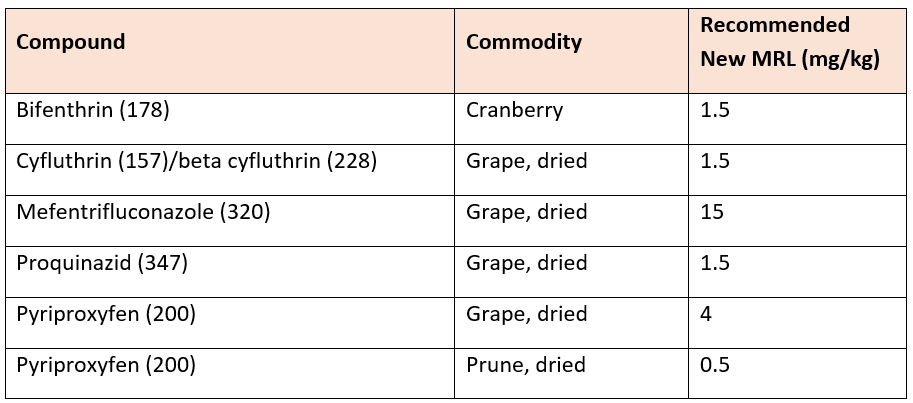
INC members who wish to provide feedback on any of these proposed MRLs may do so by filling in this form before July 15, 2026.
Codex Requests Comment on Prioritization for Review of Codex Standards for Contaminants
Codex Alimentarius has issued circular letter CL 2026/64-CF inviting Codex members and observers to comment on which contaminant standards should be prioritized for review.
Specifically, Codex members and observers are invited to:
Recommend additional standards from Lists A and B for inclusion in the Overall Highest Priority List based on the prioritization criteria or other clear, reasonable rationale that aids in prioritization.
Recommend standards already in the Overall Highest Priority List that could be considered the highest priority for review based on the prioritization criteria or other clear, reasonable rationale that aids in prioritization.
The following standards affecting nuts, which are now 15-25 years old, are included in List A:
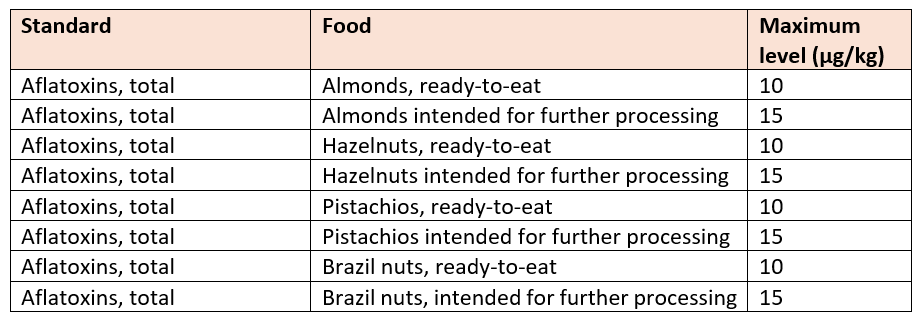
The standard for total aflatoxins in peanuts intended for further processing, for which the Codex ML is currently 15 µg/kg, remains on the Overall Highest Priority List for possible review.
Moreover, the list of Codex sampling plans requiring review for alignment with the Guidelines on Sampling (CXG 50-2004) includes the following:
Total aflatoxins in peanuts intended for further processing.
Aflatoxin contamination in ready-to-eat tree nuts and tree nuts destined for further processing: almonds, hazelnuts, pistachios and shelled Brazil nuts.
Aflatoxin contamination in dried figs.
INC members who wish to provide feedback may do so by filling in this form before September 1, 2026.
Codex Requests Comment on Priority List of Contaminants for Evaluation or Re-evaluation by JECFA
Codex Alimentarius has issued circular letter CL 2026/35-CF inviting Codex members and observers to comment on the priority list of contaminants for evaluation or re-evaluation by the Joint FAO/WHO Expert Committee on Food Additives (JECFA), which is available in Appendix XI of the report of the 18th Session of the Codex Committee on Contaminants in Foods (CCCF18, 2025).
Among other items, the priority list of contaminants for evaluation by JECFA includes the following:
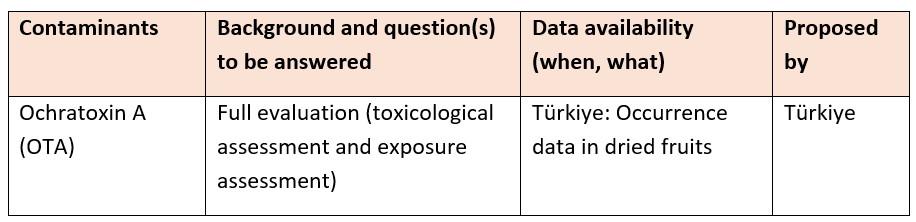
INC members who wish to provide feedback may do so by filling in this form before September 1, 2026.
Mexico to Distribute Seeds to Support 3,320 Seasonal Farmers; Peanuts Within Scope
The government of the Mexican state of Sinaloa is advancing the implementation of a seed distribution program aimed at supporting 3,320 seasonal farmers during the 2026 agricultural cycle, according to statements from the state’s agriculture department reported by Debate. Authorities indicated that applications have already been submitted and are currently under review, with distribution set to begin once validation is completed.
Officials noted that the rollout of seeds will depend on rainfall conditions. Distribution is expected to take place in two phases aligned with crop calendars, with the first scheduled for mid-July and a second phase planned for October.
The program includes an allocated budget of approximately 15 million pesos (around US$850,000) and will cover a range of crops, including peanuts, sesame, safflower, beans, native maize and chickpeas. The support is specifically targeted at rain-fed farmers operating in areas with limited access to irrigation infrastructure, aiming to facilitate planting activities and stabilize crop production.
Authorities indicated that rainfall has already begun in certain regions, suggesting that planting conditions may soon allow for the timely distribution and use of seeds.
EU Publishes New Pesticide MRLs
The European Commission has published new maximum residue limits (MRLs) for various substances:
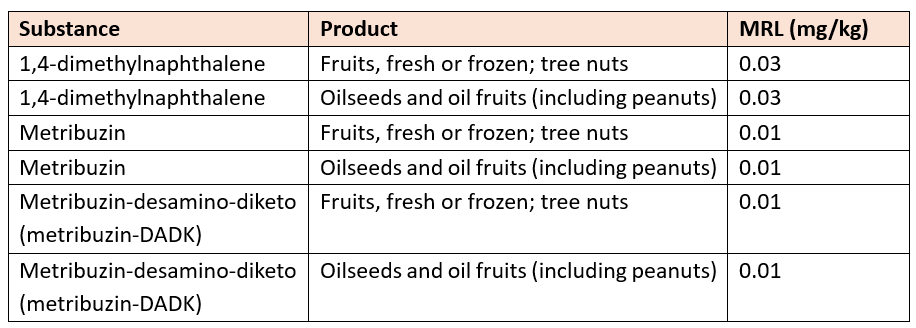
The new MRLs will apply from January 6, 2027. Products placed on the market before this date will be subject to the previous rules.
European Parliament Adopts Regulation on New Genomic Techniques
On June 17, 2026, the European Parliament adopted the regulation establishing a legal framework for new genomic techniques (NGTs).
The new EU rules mark a shift towards regulating plants on the basis of what they finally look like genetically and not how they were made. NGT-altered plants are to be split into two categories with different legal obligations:
NGT-1: This category is for plants with a limited number and type of changes that could have occurred through conventional breeding. Once it has been verified that they meet the criteria for NGT-1 status, they will be treated like conventional plants.
NGT-2: This category is for plants that have undergone more extensive or complex genetic modifications. These are covered by the existing strict GMO rules and will be subject to risk assessment. An authorization must be obtained before these plants can be commercialized in the EU.
Based on a request by Parliament, plants engineered for herbicide tolerance or to produce insecticidal substances cannot become NGT-1 plants.
Full traceability and labelling will remain obligatory for NGT-2 plants and EU countries may restrict or prohibit their cultivation even if authorized for cultivation in the EU. Plant varieties containing or derived from an NGT-1 plant will be listed in a public EU database and all seed bags and reproductive material must be labelled NGT-1, to allow farmers to make an informed choice.
To steer the use of NGTs towards developing plants with sustainability features (e.g., climate and pest resistance), the regulation makes it mandatory to monitor the sustainability impacts of NGT plants.
No NGTs will be allowed in organic production but the technically unavoidable presence of NGT-1 plants would not constitute non-compliance. The Commission will assess whether this regulation creates any administrative, economic or practical burdens for organic operators, including relating to their own perception and that of consumers.
The rules will apply both to plants originating in Europe and to those imported.
The regulation will enter into force 20 days after it has been published in the Official Journal of the European Union and will apply two years later.
Argentinean Waterway Project Award Expected to Reduce Logistics Costs by 13.5%
The Argentinean government has formalized the award of the Paraná-Paraguay waterway concession, a key logistics corridor for agricultural products. According to the Buenos Aires Times, the contract was awarded to a consortium formed by the Belgian firm Jan De Nul and the Argentinean company Servimagnus following a competitive bidding process.
Around 80% of Argentina’s foreign trade is transported via the Paraná-Paraguay waterway, which stretches more than 1,500 kilometers and flows into the Atlantic Ocean. Under this new concession, planned upgrades including dredging work, maintenance of navigational aids and enhancements to safety infrastructure. According to the Ministry of Economy, one of the main outcomes of the project will be a reduction of approximately 13.5% in logistics costs.