
ECB Raises Rates by 25 bps as Inflation Pressures Persist Despite Weakening Growth Outlook
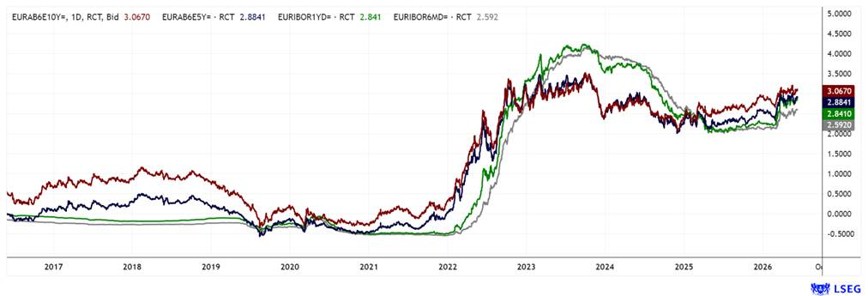
The European Central Bank (ECB) has met expectations by raising interest rates by 25 basis points in the Eurozone. Unanimously, it has set the deposit facility rate at 2.25%, the main refinancing rate at 2.40%, and the marginal lending facility at 2.65%. This marks the first rate hike in the last three years, driven by the inflationary impact of the conflict in the Middle East.
Significant price pressures have been observed, with inflation reaching 3.2%. This is further compounded by an uncertain outlook, with upside risks to inflation and downside risks to economic growth. The ECB has also stated that the medium-term implications of the conflict will depend on the intensity and duration of energy price shocks, as well as the magnitude of indirect and second-round effects.
The ECB also acknowledges that this decision and those that could be taken under different scenarios may have significant implications for the European economy, negatively affecting disposable income, wages and the household basket, leading to a decline in confidence and consumption, and resulting in a deterioration in economic growth. All of this is aimed at bringing inflation back to around the 2.0% target.
The ECB has also revised its macroeconomic projections for the coming years. GDP growth has been revised downward, placing 2026 at 0.8%, 2027 at 1.2%, and 2028 at 1.5%. Interestingly, they expect employment to continue growing, with the unemployment rate declining from 6.3% this year to 6.0% in 2028, according to the ECB’s June 2026 staff macroeconomic projections. Regarding inflation, they expect it to remain elevated in 2026 at 3.0%, before easing to 2.3% in 2027 and 2.0% in 2028.
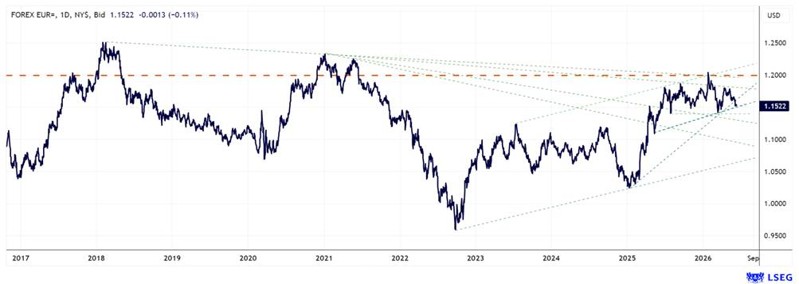
According to EY, the market impact of this decision has been limited. The interbank market had already priced in this move, and interest rates have remained broadly unchanged. Regarding the USD/EUR exchange rate, the euro is showing weakness, putting pressure on the 1.1520 USD support level. The economic outlook presented by the ECB and the different potential scenarios, together with ongoing geopolitical uncertainty, do not support demand for the euro in the markets.
USD/EUR exchange rate, 2017-Present
Eurozone Interest Rates, 2017-Present
Images: London Stock exchange Group, obtained via EY.
Fertilizer Supply Risks Rise in Türkiye Amid Hormuz Disruptions
Rising geopolitical tensions in the Middle East and ongoing shipping disruptions in the Strait of Hormuz are increasing pressures on Türkiye’s fertilizer sector, which relies heavily on imports, according to the Hürriyet Daily News. While initial concerns were limited, prolonged instability is now exposing more significant risks for agricultural production and input availability.
Industry representatives reported growing logistical bottlenecks affecting fertilizer imports and exports, with some companies struggling to secure supply while others are offering available stocks at higher prices. The disruptions are particularly critical given that the Strait of Hormuz accounts for a substantial share of global fertilizer-related trade flows, including sulfur and urea.
The situation is raising concerns about fertilizer affordability and usage, especially as sulfur—a key input in phosphate fertilizers—faces supply constraints. Reduced fertilizer use could lead to lower crop yields and quality, particularly in lower-income countries where farmers are more sensitive to price increases.
In Türkiye, where approximately 90% of chemical fertilizers are imported, the impact is especially pronounced. Key sectors such as cereals, fruits, vegetables and nuts—including hazelnuts—depend heavily on sulfur- and phosphate-based fertilizers. Agricultural stakeholders warned that prolonged supply disruptions during peak usage periods could significantly affect both producers and input suppliers.
Experts also cautioned that continued shortages may push farmers toward alternative fertilizers, although these substitutes may not fully replicate the effectiveness of sulfur-based products.
At the time of this report, it was unclear what immediate impact the US-Iran deal announced on June 15 would have on commercial shipping in the region. Senior US officials told Reuters that ship traffic in the Strait of Hormuz was expected to gradually ramp up.
EU Moves to Simplify Fertilizer Rules
On June 16, 2026, Council and Parliament negotiators reached a political agreement on the Commission’s “omnibus VI” package, which would simplify provisions relating to fertilizers, among other products.
The co-legislators agreed to simplify the EU’s fertilizing products regulation, with the aim of supporting EU farmers and innovation and competitiveness in the EU’s fertilizer sector without compromising health and environmental protection.
The Commission had proposed replacing the extended REACH registration requirement—an additional registration obligation that applies to certain substances used in fertilizing products beyond the standard requirements of the EU’s REACH Regulation (Registration, Evaluation, Authorization and Restriction of Chemicals)—with the ordinary REACH regime. However, the co-legislators chose to retain a registration obligation for substances that have a harmonized classification as particularly harmful.
The informal agreement must now be endorsed by both Parliament and Council. It will then enter into force 20 days after it has been published in the Official Journal of the European Union.