EU: Update on Timing of Increased Nickel ML in Pecans
As noted in previous INC updates, the European Commission is working on raising the maximum level (ML) for nickel in pecans from 3.5 mg/kg to 10 mg/kg. According to FRUCOM, due to internal delays, a vote to amend the ML will not be possible in June as was previously reported. The Commission is examining the possibility of having the higher ML enforced by a statement to be agreed by Member States at the Standing Committee meeting on June 19, 2026.
EU: MOAH MLs Clear Committee Hurdle; Tree Nuts and Peanuts Affected
According to FRUCOM, the Standing Committee on Plants, Animals, Food and Feed (SCOPAFF) adopted, with minor amendments, the European Commission’s proposal on maximum levels for mineral oil aromatic hydrocarbons (MOAH) in food on May 13, 2026. FRUCOM reports that Germany and the Netherlands have begun enforcing the new levels ahead of publication in the Official Journal. The draft levels for the sector are:
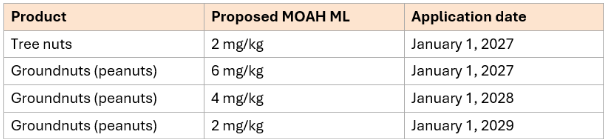
Products lawfully placed on the market before the applicable dates may remain until their minimum durability or use-by date.
EU: Member States Endorse Proposal to Lower MRLs for Three Banned Pesticides
EU Member States endorsed the European Commission’s proposal to lower the maximum residue levels (MRLs) of carbendazim, benomyl and thiophanate-methyl—three pesticides not authorized in the EU but still used in some third countries—to the limit of determination. The change affects imported food and feed, including dried apricots, prunes, raisins, pistachios and almonds from origins where these substances remain in use.
Food business operators will have a six-month phase-out period after publication in the Official Journal. The Parliament and Council have a two-month scrutiny period; absent objection, the Commission is expected to adopt the regulation in July 2026. The measure follows France’s ministerial order of January 2026 suspending the introduction, import and marketing of plants treated with the same substances.
EU: Plant Protection Products Update
The European Commission has published Implementing Regulation (EU) 2026/1154 removing methoxyfenozide, penthiopyrad and terpenoid blend QRD 460 from the list of authorized active substances. The regulation will enter into force on June 18, 2026.
The European Food Safety Authority (EFSA) has published its peer review of the pesticide risk assessment of the active substance proquinazid, concluding that this substance is an endocrine disruptor in humans.
EFSA has also published an assessment on the modification of the existing maximum residue levels (MRLs) for acequinocyl. EFSA proposes to amend the existing MRLs in various commodities, including cranberries (2 mg/kg, up from the current MRL of 0.01 mg/kg).
EU: EFSA Calls for Data Closing on June 30
Several EFSA calls for data close on June 30, 2026.
Chemical contaminants (annual continuous collection). Covers Alternaria toxins, aflatoxins, ochratoxin A and nickel, among others. As noted by European Commission officials in a recent FRUCOM meeting, EFSA is conducting a risk assessment on Alternaria toxins (alternariol, alternariol monomethyl ether, tenuazonic acid); monitored food categories under Recommendation (EU) 2022/553 include tree nuts and dried figs. Call.
Food additives (re-evaluation). Analytical and use-level data on additives permitted before January 20, 2009. Call.
Food additives and flavorings (monitoring). Analytical, use-level and presence data, including sorbic acid–potassium sorbate. Call.
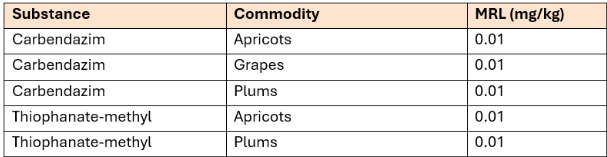
Poland: Import Ban on Products Containing Residues of Carbendazim and Thiophanate-Methyl
Poland has published a regulation that lowers maximum residue levels (MRLs) for various active substances, including the following:
EU: European Parliament Vote on New Genomic Techniques Rescheduled to June 15-18
The Council adopted the regulation establishing a legal framework for new genomic techniques (NGTs) on April 21, 2026. According to Agence Europe, the European Parliament plenary vote has been rescheduled to June 15-18.
NGT-1 plants (equivalent to conventional varieties) would be treated as conventional, with labeling required only for seeds and reproductive material; NGT-2 plants would remain under existing GMO legislation. The use of NGT-1 plants would be prohibited in organic production.
Türkiye: Revised Plant Quarantine Regulation Published; Entry Into Force August 4, 2026
Türkiye published a revised and updated Regulation on Plant Quarantine in its Official Gazette on May 6, 2026 (No. 33245) and notified the World Trade Organization (WTO) on May 18 (G/SPS/N/TUR/23/Rev.1/Add.2). The regulation will enter into force 90 days after publication, on or around August 4, 2026. The revision updates phytosanitary quarantine measures in light of current scientific findings in Türkiye and is the second revision of a text originally notified in June 2024.
Exporters to Türkiye and Turkish exporters of nuts and dried fruits are advised to review the updated text to verify whether the new regulation modifies applicable certification, inspection or quarantine treatment requirements in their supply chains. The full text is available in three annexed documents linked from the WTO notification.