
A group of US senators has introduced the Cultivating Horticultural Innovation in Local Economies (CHILE) Act, legislation to strengthen federal support for specialty crop growers facing economic losses and market disruptions. The bill would establish a Specialty Crop Emergency Assistance Framework and require the U.S. Department of Agriculture (USDA) to use this framework when providing direct assistance to specialty crop producers affected by adverse events, including economic crises or market disruptions. The bill clarifies that specialty crops include fruits and vegetables, tree nuts, dried fruits and nursery crops, and would provide US$5 billion in mandatory funding for fiscal year 2027. The CHILE Act builds on the Specialty Crop Emergency Assistance Framework already included in the House-passed Farm Bill. More information
Tanzanian Government Strategy Targets Local Processing of Cashew Sector
On June 27, 2026, the Daily News reported that Tanzania has set the objective of processing most of its cashew nut production locally by 2030, under a government strategy aimed at increasing value addition. Government authorities indicated that, by 2030, annual cashew production is expected to reach one million metric tons, with a significant share to be processed within the country.
To support this objective, the government has stated that it will continue improving the investment climate in the cashew sub-sector to attract more processors and expand local shelling capacity. One of the key initiatives is the Maranje Industrial Park, which has been equipped with roads, electricity and water to support investment in cashew processing industries. The park has been registered under the Tanzania Special Economic Zones Authority (TISEZA), enabling investors to benefit from incentives available under the special economic zones framework.
Thai-US Pesticide Testing Cooperation Aims to Support Safer Produce Trade
The Thai Food and Drug Administration (FDA) has held bilateral talks with US agricultural officials to strengthen safety surveillance of imported fresh fruit, vegetables and nuts, with discussions focused on pesticide residue monitoring and alignment of regulatory standards, according to Nation Thailand.
The meeting brought together the Thai FDA, the U.S. Department of Agriculture (USDA) Agricultural Attaché and representatives from the Assisting Specialty Crop Exports initiative. Key topics included border inspection systems, sampling methods at ports of entry, laboratory testing for chemical residues and enforcement procedures when consignments exceed maximum residue limits.
The technical exchange is expected to support longer-term cooperation between regulators, including access to US compliance data and data-sharing networks. The Thai FDA said future policy updates would remain based on scientific principles, with the aim of protecting public health while supporting international trade.
Agriculture Skills Project Targets High-Value Crop Development in Pakistan
Pakistan and Italy signed a €20 million concessional loan agreement to support the Professional Capacity Building and Extension in Agriculture project, aimed at strengthening agricultural skills development and vocational education under Pakistan’s Technical and Vocational Education and Training (TVET) National Reform Program, according to reporting by Associated Press of Pakistan republished by UrduPoint.
The project will focus on improving professional training, technical certification and innovation across agricultural value chains, with dedicated support for horticulture production, processing and marketing. It will target several high-value crops, including almonds, pistachios and dates, alongside olives, mushrooms, cherries, grapes and peaches.
Over a 42-month period, the program is expected to deliver 720 training courses for more than 18,000 participants, including farmers, women, youth and trainers. Planned infrastructure investments include model orchards and nurseries, eco-villages with climate-resilient technologies, agro-food processing units and two National Centers of Excellence for dates and citrus crops.
The initiative also aims to support value addition, reduce post-harvest losses, strengthen farmer cooperatives and improve the competitiveness of Pakistan’s agriculture sector, drawing on Italian expertise in modern agronomic practices.
EU Pesticides Update
The European Union has notified the World Trade Organization (WTO) of a draft regulation that would lower all maximum residue levels (MRLs) for eight active substances which are no longer approved in the EU, including the following:
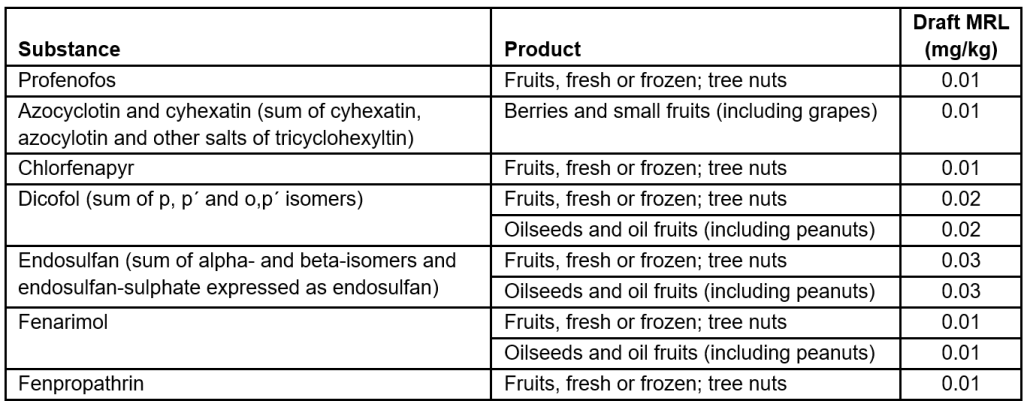
The proposed date of publication is March 1, 2027, and the regulation would enter into force 20 days later. The comment period is open until August 25, 2026.
UK Guidance Outlines Requirements for Importing Nuts
On June 25, 2026, the UK’s Food Standards Agency published guidance on labeling, contaminants and what to look out for when importing nuts. The guidance sets out that nut imports from third countries must meet the same food hygiene standards and follow the same procedures as food produced in Great Britain. It also states that importers do not normally need a health certificate for nuts unless the products are subject to emergency control procedures.
The guidance covers labeling, organic products, packaging, food hygiene, contaminants and import restrictions. It also notes that certain nut products from specific origins are subject to special conditions due to aflatoxin contamination risk, including peanuts from Brazil, China, Egypt, Ghana and India; hazelnuts and pistachios from Türkiye; pistachios from Iran; and Brazil nuts from Brazil. Consignments of these products can only enter Great Britain through specific ports or airports which are designated border control posts. The guidance also provides information about pre-export checks on peanuts and derived products from the United States.
Kenyan Traceability System Targets Pesticide Residue Risks in Export Supply Chains
Kenya has launched a National Horticulture Traceability System to improve compliance with international food safety standards and reduce the risk of export interceptions in key markets such as the European Union, according to The Star. The platform, developed by the Agriculture and Food Authority, will allow fresh horticultural produce to be traced from individual farms through the supply chain to export markets.
The system is designed to strengthen accountability when consignments are intercepted due to pest infestations or excessive pesticide residues. Under the new platform, farms will be digitally mapped and registered using geolocation technology, while production records will include information such as planting dates, crop varieties, pesticide applications, harvesting and movement through the supply chain. Export volumes will also be compared with the estimated production capacity of registered farms to identify inconsistencies. The platform will initially focus on export horticulture before being expanded to domestic markets and other agricultural value chains, including macadamias and coconuts.