
The information contained herein was prepared between mid-September and October 2026.
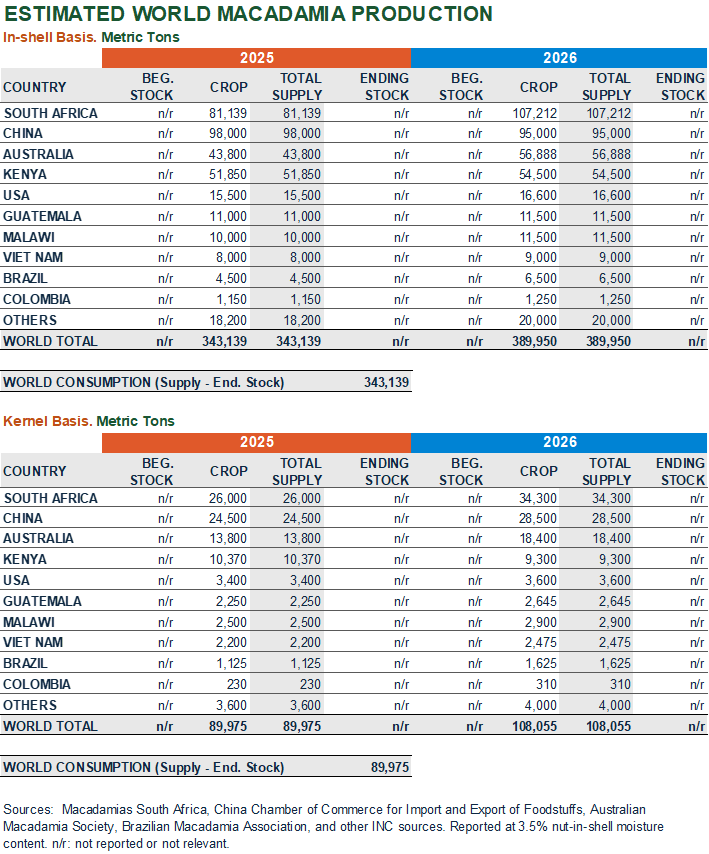
South Africa. According to SAMAC and industry sources, the 2026 crop is now forecasted at 107,000 metric tons dry nut in shell (NIS), exceeding initial expectations of around 95,000 MT (+ 12.6%) and standing 32% above the 2025 crop of 81,000 MT. This was largely driven by an exceptional crop in KwaZulu-Natal, where both quality and nut sizing were excellent. Production in Mpumalanga also exceeded expectations. Approximately 50–55% of the crop is expected to be exported as in-shell, primarily to China, with the balance processed into kernel, broadly in line with 2025 levels.
Early indications for the 2027 crop are concerning. Wet weather during the September–October flowering period, followed by unusually hot and dry conditions, has raised concerns about potential crop development. With El Niño conditions developing, drought risk is a particular concern, given the significant proportion of South African orchards that are rain-fed.
China. The 2026 harvest was nearing completion by early October, with the output forecasted at 95,000 MT, down from the earlier forecast of 108,000 MT and lower than the 2025 crop. Drought in March–April stunted nut development and increased small-sized nuts, and heavy rains in July–August triggered substantial drop-off of mid-mature nuts, the primary cause of reduced production. Guangxi, the second-largest producing region, saw an output decline of 30–40%, while Yunnan suffered unusually severe pest damage of 15–20%.
Australia. As reported by the Australian Macadamia Society, the 2026 crop forecast remains at 56,888 MT in-shell at 3.5% moisture, with a forecast range of 60,000 to 62,000 MT at 10% moisture.
In July and reviewed again in August, the Australian Macadamia Handlers Association data showed an increase of approximately 1,700 MT from the March forecast, as the New South Wales deliveries were continuing on a longer-than-normal tail following weather interruptions and withholding periods associated with some orchard chemicals.