
The information contained herein was prepared between mid-September and October 2026.
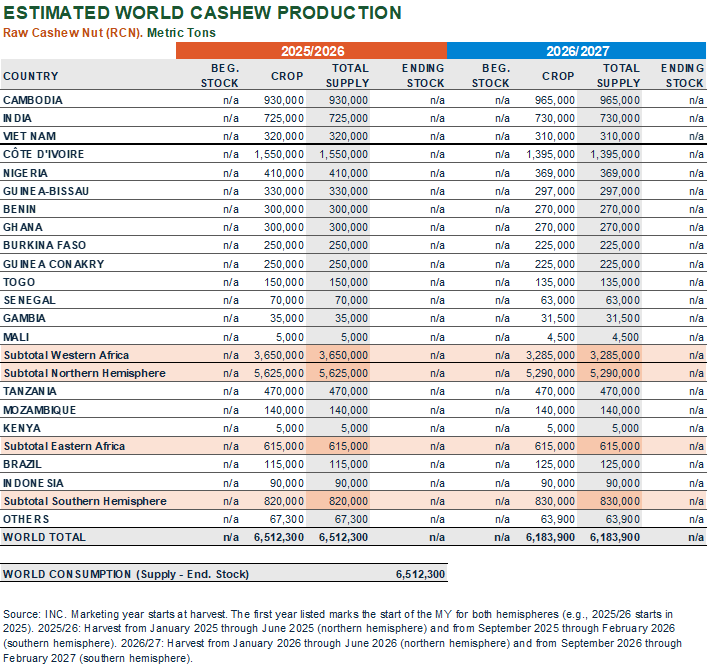
With an estimated 10% crop shortage in West Africa, the Northern Hemisphere crop is projected to be 6% lower than in 2025. Crop quality was also reported below last year across major origins. Arrivals from West African origins into Viet Nam, India and Cambodia reportedly showed higher defect levels and lower outturns than last season. Consequently, availability of raw cashew nuts (RCN) remained tight, particularly for premium-grade. In Viet Nam, processing activity slowed due to limited RCN availability, with processors reportedly under-covered for Q4 requirements and reluctant to source from West Africa due to quality concerns.
By September, cashew harvests in the Southern Hemisphere were underway amid concerns over a strengthening El Niño. In Tanzania, favorable weather conditions pointed to a crop similar to 2025, although rainfall during harvesting could affect the final outcome. RCN auctions were expected to begin in November. Sources from Brazil reported that the 2025 harvest is estimated at 115,000 metric tons, reflecting a poor crop. For 2026, however, production is anticipated to be better, as crop conditions appear very favorable. One of the main challenges this season is the availability of seasonal labor for harvesting. Meanwhile, the domestic market continues to gain importance, both for large-scale shellers and for smaller domestic roasters.
Looking ahead, El Niño is forecast to strengthen further toward the end of 2026, which could adversely affect the ongoing Southern Hemisphere harvests and the development of the 2027 crops. It may also negatively impact next year’s Northern Hemisphere crops. Early indications for the 2027 crop remain preliminary, with flowering, rainfall patterns and subsequent pod set expected to provide a clearer indication of production potential in the coming months.
On the demand side, strong consumption growth in China, India, the Americas, and the rest of Asia is more than offsetting weaker demand from the Middle East and, to a certain extend in recent months, in Europe. Overall, global demand is expected to increase by 6-7% in 2026 compared to 2025. Consequently, the market is anticipated to face a supply deficit by the end of 2026.