
The information contained herein was prepared between mid-September and October 2026.
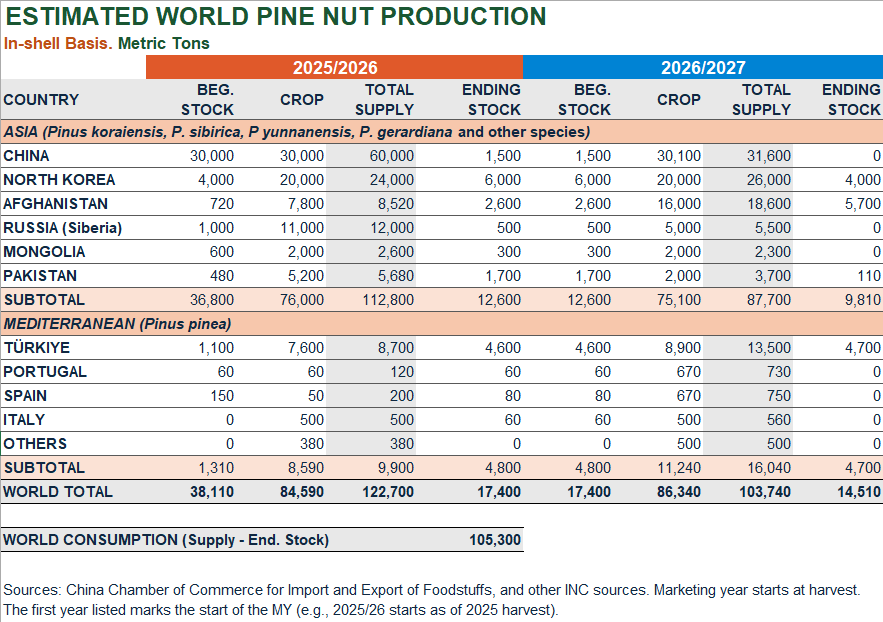
China. The Chinese 2026 crop has been revised down by 50% from the preliminary forecast in May, to 30,100 metric tons in-shell. The great extent of the impact of earlier adverse weather conditions became clearer during late spring and summer of this year. In spring 2025, when the reproductive structures that would form the 2026 cones were developing, high temperatures, drought and irregular rainfall affected pollination and young cone development much more than predicted, resulting in significant empty cones and young cone shedding. Localized pest activity also caused further losses.
In-shell production accounts for 24,000 MT of Pinus koraiensis, 4,000 MT of P. yunnanensis and 2,100 MT of P. armandii. Kernel output reaches 7,500 MT, at a 25% kernel yield. A minimum of two-thirds of home-grown P. koraiensis supply domestic consumption, only the balance goes for export, along with the other species. The ending stock is expected to be zero due to strong in-shell market by the Mid-Autumn/Chinese National holiday season sales.
Russia. The 2026 crop has also been revised significantly down, with production now expected to be exceptionally low at approximately 5,000 MT in-shell. An unusually warm spring in 2025 accelerated reproductive development, leaving the structures particularly sensitive when late frosts occurred at the end of May. The resulting damage led to lower-than-expected cone availability, with field assessments subsequently rating the 2026 crop even lower. P. sibirica production in Siberia is virtually nonexistent, compared with around 60,000 MT in a bumper year. The P. koraiensis crop is estimated at just 3,000 MT, with a kernel recovery ratio of 28%, against approximately 20,000 MT in a normal season. In Sakhalin and the Kamchatka Peninsula, P. pumila production is expected to reach around 2,000 MT in-shell, with a kernel recovery rate of approximately 35%. Collection efforts have shifted toward this region due to the severe shortage elsewhere. Given the exceptionally limited availability, supplies are expected to be directed primarily at the domestic market, with no exports anticipated this season.
Mongolia. Pine nut harvesting for both household and commercial purposes was prohibited by the authorities this year in the main growing area, following a weak natural crop and limited food availability for wildlife. Thus, although there might be a crop of around 2,000 MT in-shell, the commercially available supply is expected to be extremely limited.
Mediterranean. The crop outlook remains unchanged, with very low pine cone availability. High temperatures have affected kernel development, resulting in a high proportion of empty shells. Harvesting was expected to begin in mid-November, although labor shortages may pose an additional challenge. At the time of reporting, prices started at €70/kg.