European Parliament Passes Tariff Regulation: 0% on US Dried Fruits and Quota for US Tree Nuts
On June 16, 2026, the European Parliament passed legislation implementing the tariff elements of the August 2025 EU-US Joint Statement. In addition to setting customs duties at 0% for various dried fruits from the US, the legislation envisages a 500,000‑metric‑ton tariff-rate quota for US tree nuts entering the EU market.1
On May 20, 2026, the Council presidency and European Parliament negotiators reached a provisional agreement on two regulations, including the main regulation that adjusts duties and opens tariff quotas for selected US goods. On June 2, Parliament’s International Trade Committee (INTA) approved the compromise, and a plenary vote took place on June 16, in Strasbourg. Following Parliamentary approval, the Council will still need to give its final sign-off before publication in the Official Journal, with entry into force the following day. The revised text also includes stronger safeguard provisions, reinforced suspension clauses and a sunset clause under which tariff preferences would expire on December 31, 2029, unless renewed.
This regulation helps take a renewed transatlantic tariff confrontation off the table for the covered products. In April 2025, the EU adopted and then suspended countermeasures against US goods in response to Washington’s steel and aluminum tariffs. Those measures included an additional 25% duty on US almonds, scheduled to apply from December 1, 2025, while peanut butter and dried cranberries also featured in the suspended package. The European institutions are now trying to complete implementation of the 2025 transatlantic deal before a politically sensitive July deadline, amid explicit US pressure for the EU to honor its commitments. For the nut and dried fruit trade, in addition to shaving a few percentage points off ordinary customs costs, the regulation replaces a destabilizing tariff overhang with a more predictable, rules-based framework.
Looking ahead, the practical questions are: when the final text will be published in the Official Journal; how the quota will be administered in customs practice; and whether any additional implementing detail will affect how quickly importers can begin using the new preference. Companies should also keep an eye on the regulation’s built-in safeguards. Parliament and Council have strengthened the suspension mechanism so that the Commission can suspend all or part of the concessions if the United States fails to meet its commitments under the Joint Statement or otherwise undermines the objectives of the agreement. The 2029 sunset clause is another reminder that this is a stabilizing arrangement, but not a permanent settlement. For operators in the sector, the likely immediate commercial effect is improved short-term predictability—but not a complete end to transatlantic tariff risk.
1 The legislation sets a 0% customs duty for products including the following: dried sultanas (0806 20 30), dried grapes excluding currants and sultanas (0806 20 90), dried apricots (0813 10 00), dried prunes (0813 20 00), dried fruit – other (0813 40 95), and cranberries (2008 93). The tariff rate quota includes CN code 0802, which includes almonds, hazelnuts, walnuts, pistachios, macadamia nuts, pine nuts and pecans, whether shelled or in-shell, and CN code 200819, “Nuts and other seeds, including mixtures, prepared or preserved (excluding groundnuts)”—a category that includes roasted almonds and pistachios.
Taiwanese Authorities Probe Possible Peanut Price Manipulation Amid Market Pressures
Taiwanese authorities have launched an investigation into potential price manipulation in the domestic peanut market, following concerns that purchasing prices in key production areas may have been artificially suppressed, as reported by Taiwan News. The probe comes amid reports of falling farm-gate prices, which have reached their lowest levels in a decade.
Market participants point to a combination of factors behind the downturn, including leftover inventory from the 2025 harvest and expectations of increased competition from tariff-free US peanut imports under the US-Taiwan Agreement on Reciprocal Trade. While government officials have downplayed these concerns, industry stakeholders warn that cheaper imports could further pressure domestic prices. Additional challenges, including delayed harvesting due to adverse weather and concerns over uneven product quality, have contributed to weaker demand and cautious buying behavior.
Raw Cashew Export Ban in Benin Fails to Deliver Expected Boost to Domestic Processing
More than two years after Benin introduced a ban on raw cashew exports to promote domestic value addition, the policy has yet to achieve its primary objective of expanding local processing capacity, according to an analysis published by Ecofin Agency. Despite the measure, less than 30% of the country’s annual cashew output is currently processed domestically, with most of the production continuing to leave the country through informal cross-border trade routes, according to industry sources cited by Ecofin.
Industry estimates suggest that around 70% of Benin’s cashew crop is diverted via neighboring countries such as Togo and Nigeria before reaching key global markets, including India and Viet Nam. This highlights ongoing structural challenges within the sector, where local processors often lack the financial resources, infrastructure and market incentives needed to compete with external buyers.
The persistence of unofficial trade flows, even after the implementation of export restrictions and tighter border controls, underscores the limited effectiveness of the policy in reshaping supply chains. At the same time, stakeholders warn that if domestic processors are unable to absorb production at competitive prices, downward pressure on farm-gate returns could ultimately discourage growers and threaten the long-term viability of the sector. More broadly, Benin’s experience reflects the complexities of using export bans to drive industrial development, particularly in cases where downstream capacity and market mechanisms remain underdeveloped.
UK Launches Public Consultation on Cost-of-Living Tariff Suspensions
In response to the conflict in the Middle East, the UK government is exploring whether the temporary suspension of certain import tariffs could lead to benefits for households and families. A first round of temporary tariff suspensions on a selection of agricultural and food products was announced in May 2026 will last until December 2028. The government is now seeking stakeholder views through a call for input on the goods considered within a second cost-of-living tariff suspensions package. The list of goods for potential tariff suspensions includes various nuts and dried fruits. The deadline to provide input is June 24, 2026.
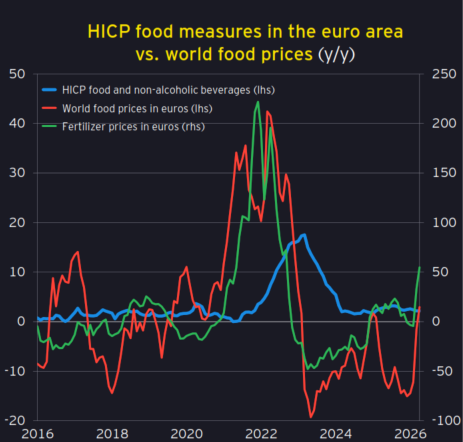
Source: EY’s June 2026 European Economic Outlook.
North American Agriculture Coalition Urges Renewal of USMCA Ahead of July 1 Review
Nearly 160 food and agriculture organizations from the United States, Canada and Mexico sent a joint letter on June 5, 2026, to trade officials in all three countries urging the renewal and strengthening of the United States–Mexico–Canada Agreement (USMCA)—which governs a significant share of cross-border nut and dried fruit trade—ahead of the agreement’s mandatory six-year review, scheduled for July 1, 2026. The review could result in a 16-year extension, termination of the agreement, or annual consultations if the parties cannot reach consensus.
Organized by the Agricultural Coalition for USMCA, signatories include the American Farm Bureau Federation, the National Association of State Departments of Agriculture (NASDA), Farmers for Free Trade, the Canadian Agri-Food Trade Alliance and Mexico’s Consejo Nacional Agropecuario. The coalition argued that the agreement’s integrated structure—spanning more than 500 million consumers and approximately US$1.7 trillion in annual trade volume—provides the predictability North American agricultural trade depends on. Signatories emphasized that outstanding disputes should be resolved through existing mechanisms rather than unilateral retaliatory measures.
India-US Trade Talks Conclude in New Delhi; First Tranche of Bilateral Agreement Targeted for Mid-July
A US delegation was in New Delhi from June 2-4, 2026 to advance the interim bilateral trade agreement, with both sides reaffirming their commitment to a Bilateral Trade Agreement covering goods, non-tariff measures and customs facilitation. Speaking on June 5, Indian Commerce Minister Piyush Goyal told Business Standard that the two countries are close to concluding open issues and could execute the first tranche by mid-July, with a high-level US team expected in New Delhi toward the end of June.
Under the US-India Joint Statement of February 7, 2026, India committed to eliminate or reduce tariffs on a range of US food and agricultural products. Tree nuts are among the products in scope.
USDA Trade Mission Targets Expansion of US Tree Nut Exports in Argentina and Ecuador
In early June 2026, the USDA Foreign Agricultural Service (FAS) launched a trade mission to Argentina and Ecuador aimed at converting existing trade framework commitments into increased export sales for US agricultural products, including tree nuts. The mission, led by the Under Secretary for Trade and Foreign Agricultural Affairs, includes business-to-business meetings and direct engagement with local buyers and government officials.
Ecuador has committed under its trade framework with the United States to eliminate or reduce tariff barriers on tree nuts and other agricultural products. The mission is expected to support US nut exporters in strengthening their market position across Latin America.
USDA Opens Applications for US$1.625 Billion Specialty Crop Farmers Assistance Program; Tree Nuts and Dried Fruits Eligible
The USDA finalized the Assistance for Specialty Crop Farmers (ASCF) Program on May 29, 2026, making US$1.625 billion in one-time bridge payments available to producers of eligible fruits, vegetables and tree nuts based on 2025 planted acreage, according to FreshPlaza. Applications opened June 1 and close August 7, 2026, under the broader Farmer Bridge Assistance Program.
Eligible nut and dried fruit crops include almonds, cashews, hazelnuts, pecans, pistachios, walnuts, apricots, cranberries, grapes (processed), prunes and raisins. Payments range from US$25 to US$650 per acre across four revenue-based tiers. Producers must have filed a 2025 crop acreage report (FSA-578) by April 24, 2026. Pre-filled applications have been available online since June 1 and in-person at local FSA offices since June 8.
Kenyan Macadamia Sector Calls for Temporary Export Ban Suspension as Stockpiles Mount
Macadamia growers in Kenya have renewed calls for government intervention to address a growing backlog of unsold produce, including a proposal to temporarily suspend the ban on the export of raw, in-shell macadamia nuts, according to The Standard. Speaking at a stakeholder meeting convened by the Agriculture and Food Authority (AFA) at KALRO Seeds in Thika on June 5, 2026, Mt Kenya Macadamia Cooperative Society Chairman Gitonga Gathua said farmers are facing significant hardship due to limited processor purchasing capacity and accumulating on-farm stockpiles.
Stakeholders proposed that the export ban be suspended for at least six months to allow inventories to clear and reduce the risk of quality deterioration from prolonged storage. A parallel proposal called for government-backed commodity financing to allow cooperatives to purchase produce from farmers directly before supplying processors. Acting AFA Director of the Nuts and Oil Crops Directorate John Athola acknowledged the challenges; recommendations are to be forwarded to the Cabinet Secretary for Agriculture.
Taiwanese Government Moves to Protect Domestic Peanut Varieties Amid Trade Liberalization Concerns
Taiwan’s agricultural authorities are pursuing two parallel measures to protect the competitive position of domestic peanut growers. According to the Taipei Times, the Taiwan Ministry of Agriculture is advancing restrictions on the export of peanut seeds under the Plant Variety and Plant Seed Act, targeting high-value varieties such as Tainan No. 14 and Black King Kong—considered central to Taiwan’s premium peanut identity—at risk of unauthorized transfer abroad.
Separately, the government is taking steps to support domestic growers facing potential competition from US peanut imports under the Taiwan-US Agreement on Reciprocal Trade (ART), according to another article in the Taipei Times. Measures include purchasing fresh peanut pods, establishing drying centers to reduce production costs and requiring processed products to clearly indicate country of origin. Peanut cultivation in Taiwan has declined from approximately 19,000 hectares in 2020 to 15,000 hectares in 2025.