
Exclusive INC Networking Reception at SIAL Paris 2026

The INC is pleased to invite you to its exclusive Networking Reception at SIAL Paris 2026 Join us for an evening of relaxed networking, good conversation, and connections with fellow INC members and industry professionals. Enjoy a selection of drinks, premium nuts and dried fruits while taking the opportunity to reconnect with colleagues, meet new […]
INC Congress: Sponsorship Opportunities Are Filling Fast

Secure high-profile visibility at the leading global event for the nut and dried fruit industry, May 5–7, 2027 Planning is already underway for INC Congress 2027 in Rio de Janeiro, taking place May 5–7 and expected to bring more than 1,200 nut and dried fruit professionals worldwide. As the industry’s leading global gathering, Congress is […]
African Cashew Producers Push for Greater Local Processing and Policy Alignment
African cashew-producing countries are seeking to retain more value from the crop through local processing, stronger regulation and greater coordination. At a recent conference in Accra, Ghana’s Minister of Food and Agriculture said that Africa produces around 58% of the world’s raw cashew nuts but processes only about 20% of the crop, according to the […]
Türkiye Completes 2026 Hazelnut Field Studies on Pest-Control Effectiveness
Türkiye’s Black Sea Agricultural Research Institute completed its 2026 branch-cage field studies in hazelnut orchards on September 18. The work was conducted with provincial and district agriculture authorities across Samsun, Ordu, Giresun and Trabzon. The studies covered 18 hazelnut orchards across the four provinces and evaluated the field effects of pest-control measures applied during the […]
Türkiye Sets September 28 as First Export Loading Date for 2026 Dried Fig Crop
Türkiye has set September 28, 2026, as the first loading and export date for the new dried fig crop, according to an announcement from the Southeastern Anatolia Exporters’ Associations based on information from the Ministry of Trade’s Aegean Customs and Foreign Trade Regional Directorate. From September 28, member companies and customs brokers will be able […]
UK Moves Forward With Plans to Modernize Food-Safety Regulation
The UK Food Standards Agency (FSA) Board agreed on September 16, 2026, to move forward with the design of reforms under its Future of Food Regulation program. The proposals are intended to strengthen local enforcement while introducing a more consistent national approach to the oversight of the largest food businesses. The planned model includes improved […]
UK Advances Preparations for Potential UK-EU Sanitary and Phytosanitary Agreement
The UK Food Standards Agency (FSA) published an update on September 15, 2026, on its preparations for a potential UK-EU Sanitary and Phytosanitary Agreement. The FSA said negotiations between the UK and EU are at an advanced stage while implementation planning, stakeholder engagement and readiness work continue. The FSA is preparing systems, processes and legislative […]
EU Public Consultation on Renewal Procedures for Low-Risk Substances
The European Commission has opened a public consultation on a draft implementing decision that would create a work program that groups and aligns the renewal procedures for seven low-risk active substances (Isaria fumosorosea strain Apopka 97, COS-OGA, cerevisane, Pepino mosaic virus strain CH2 isolate 1906, ferric phosphate, Saccharomyces cerevisae strain LAS02 and Trichoderma atroviride strain […]
Codex to Consider New Code of Practice on Ochratoxin A in Dried Fruits
The Codex Committee on Contaminants in Foods (CCCF) is preparing to consider the development of a new Code of Practice for the prevention and reduction of ochratoxin A (OTA) contamination in dried fruits at its 19th session, scheduled for October 19-23, 2026, in Cairo, Egypt. Codex has also issued a request for comments on the […]
57th Session of the Codex Committee Pesticide Residues (CCPR57)
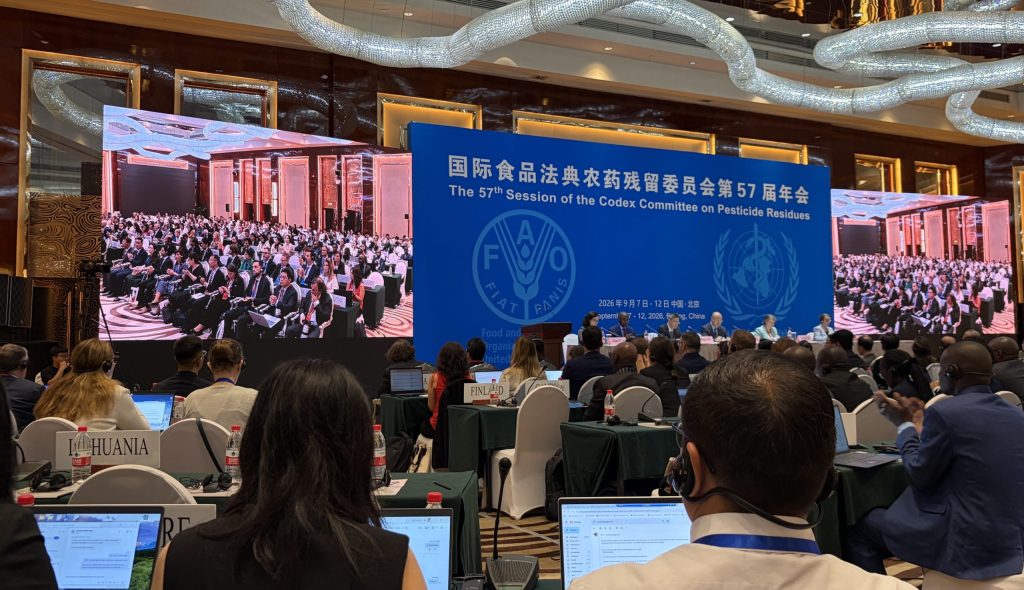
The INC participated in the CCPR57, held in Beijing, China, from September 7-12, 2026. Discussions and decisions affecting nuts and dried fruits included the following: Bifenthrin: CCPR57 agreed to advance all proposed MRLs for bifenthrin, including 1.5 mg/kg in cranberries, to Step 5/8 for adoption, noting reservations from the EU. Clethodim: The four-year rule that […]